Precision Metering & Control Lineup
Modular DIN rail intelligent energy monitoring hardware, multifunction micro-relays, and remote cycle controllers engineered for commercial distribution and distributed energy resources.
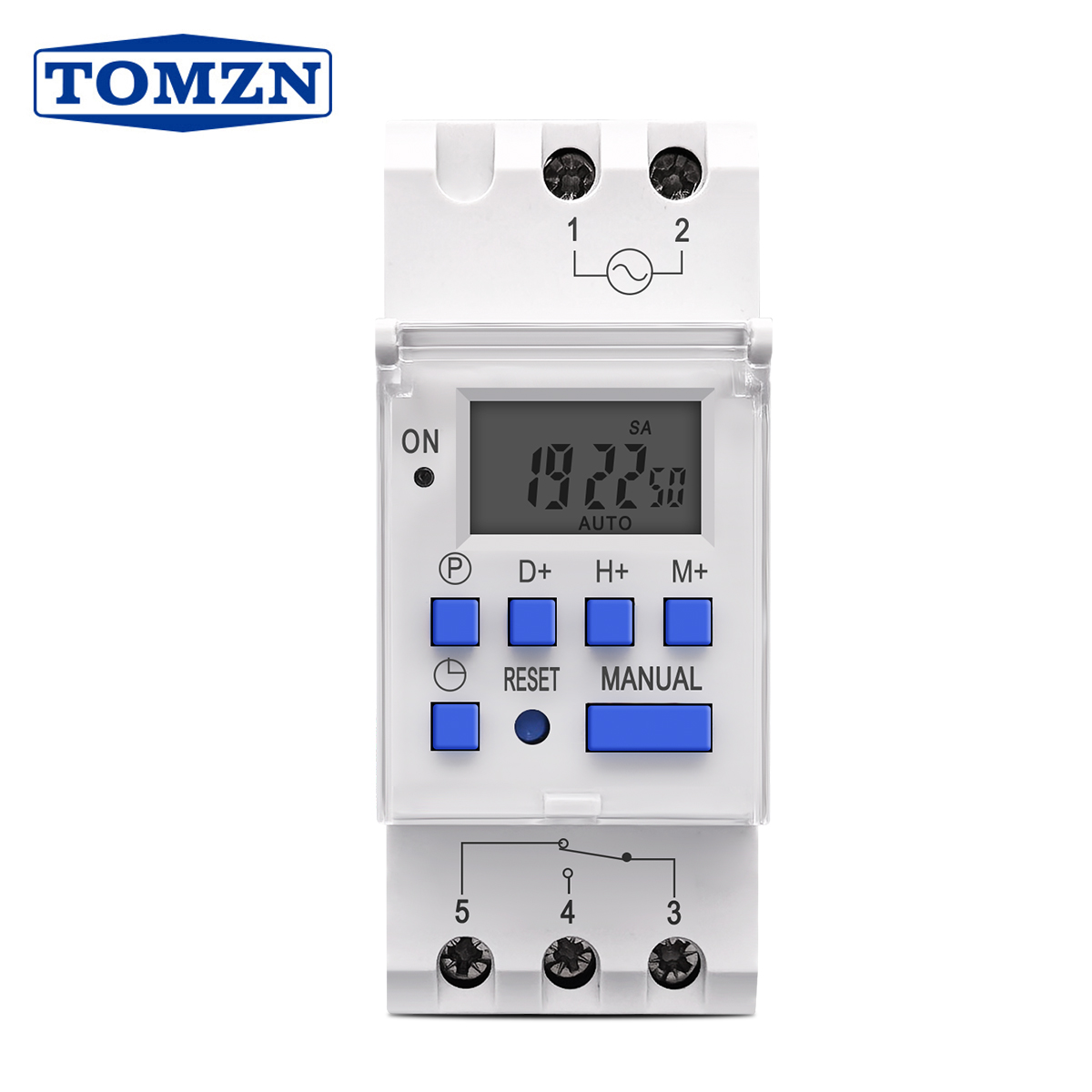
TOMZN 1NO 1NC Din Rail Single Phase Weekly 7 Days Digital TIME Relay Timer 16A
Designed for precise scheduled automated power cycles across AC 220V/230V or low-voltage 12V/24V/48V circuits with high microsecond stability.

TORT7 Series Delay-ON Delay-OFF 10in1 Asymmetric Cycler Time Relay Switch
Microprocessor-driven pulse generator and asymmetric cycler supporting intervals from 0.1s to 10 days for motor duty cycles and industrial automation.

TOMZN New Type Din Rail Single Phase Weekly 7 Days Programmable Digital Timer 16A
Upgraded LCD high-contrast metering interface supporting broad supply variance, onboard lithium backup, and anti-interference relay coils.

TOS6-40 Bluetooth Time Control Switch 35mm DIN Rail / Wall-Mount 40A AC85-265V
High-amperage 40A solid-state contact switching with local Bluetooth synchronization, countdown scheduling, and continuous loop parameters.
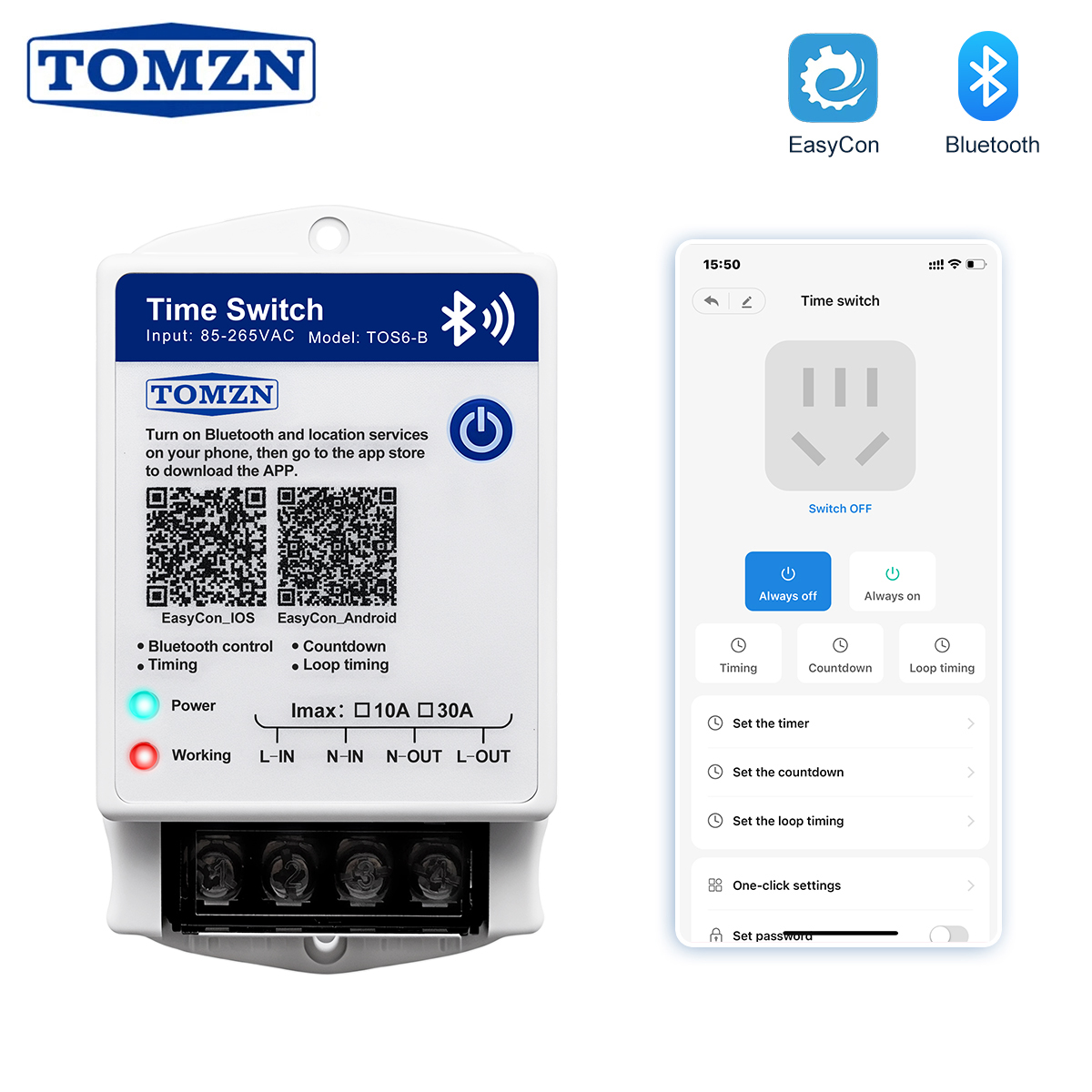
TOMZN Bluetooth Smart Timer Switch 85-265VAC 10A 30A EasyCon Wall Mount
Designed for building sub-metering systems and HVAC automation with 28 program slots, cyclical timing, and instant app sync without an external gateway.

TOMZN TOS7-B Bluetooth Smart Switch 40A 63A 85-265V EasyCon DIN Rail
Engineered for large loads up to 63A. Features remote circuit trip management, industrial DIN mounting, and real-time load cycling accuracy.

Adjustable Over/Under Voltage Protector with Active kWh Digital Meter
Integrated multi-parameter power analytics combining high-precision Class 1 active energy measurement with automated over-voltage/current cut-off.

TOB9e-63M WiFi Smart Breaker with Bi-Directional Energy Sub-Metering
Cloud-enabled sub-metering terminal reporting active power, reactive power, current draw, and historic load trends directly to mobile dashboards.
Engineering Whitepaper: Next-Generation Digital Energy Metering & Power Architecture
Modern electrical infrastructure demands accurate data collection alongside standard circuit protection. As microgrids, distributed solar photovoltaic systems, battery energy storage systems (BESS), and electric vehicle charging points (EVSE) proliferate, the traditional boundary between simple overcurrent protective devices and diagnostic instrumentation has dissolved. Zhejiang TMB Electric Co., Ltd. sits at the heart of this shift, producing hardware that bridges high-precision energy telemetry with high-reliability circuit interruption.
Operating out of China's primary low-voltage electrical hub—Liushi Town, Wenzhou—our factory leverages 24 years of manufacturing experience. We combine complete supply chain integration with quality protocols verified on-site by TÜV Rheinland. This paper outlines the technical and macroeconomic factors shaping the specification of digital energy meters, time relays, and smart monitoring devices for global B2B procurement channels.
1. Hardware Architecture: Sensor Transduction & Metering Precision
Industrial and commercial digital energy meters rely on specialized signal-conditioning topologies to translate alternating or direct currents into digitized power metrics. Specifiers must choose the appropriate transduction topology based on circuit characteristics:
- Current Shunt Resistors: Used predominantly in single-phase modular DIN rail meters up to 80A or 100A direct connection. Shunts provide high linearity and immunity to external magnetic fields, though they introduce galvanic coupling between phase lines and the measurement ASIC.
- Current Transformers (CTs): Applied in split-core or solid-core setups for three-phase commercial distribution boards or higher current thresholds (100A to 6300A). They offer galvanic isolation, but attention must be paid to phase angle error and saturation under harmonic loads.
- Rogowski Coils: Emerging rapidly in retrofit and high-density multi-circuit tenant sub-metering due to their compact, flexible profiles and absence of iron core saturation, though they require active integration circuitry.
| Architecture Metric | Direct Shunt DIN-Rail Units | External CT Incomer Meters | Smart Protective Breaker/Meters |
|---|---|---|---|
| Nominal Current (In) | 5(60)A to 5(100)A | 1A or 5A secondary (up to 3200A primary) | Up to 63A / 125A |
| Accuracy Class (Active) | Class 1.0 (IEC 62053-21) / Class B | Class 0.5S / Class 0.2S (IEC 62053-22) | Class 1.0 to Class 2.0 |
| Primary Application | Tenant billing, EV charging kiosks | Factory switchgear, MV/LV substations | Microgrid, residential automation |
| Isolation Voltage | 4 kV RMS 50Hz (1 minute) | Galvanic separation via external CTs | 4 kV withstand across poles |
| Harmonic Profiling | Fundamental kWh active energy | Up to 31st or 63rd harmonic THD (U/I) | RMS current, active kW monitoring |
2. Future Procurement Trends in Industrial Digital Metering
Procurement directors and system integrators face a rapidly evolving compliance landscape. Over the coming 3 to 5 years, digital energy meter supply chains will be guided by several key industry shifts:
Convergence of Protection and Revenue Metering: Rather than installing a dedicated miniature circuit breaker (MCB) upstream and a standalone kilowatt-hour meter downstream, panel builders increasingly specify multi-function devices. Modern modular units combine adjustable over/under-voltage relays, leakage detection, thermal-magnetic overcurrent interruption, and digital display instrumentation into a single 36mm or 54mm chassis. This cuts DIN rail width by up to 50% and reduces manual enclosure wiring by two-thirds.
Open Protocol Interoperability & Local Edge Processing: Proprietary, closed-ecosystem meters are losing ground in commercial specifications. High-volume B2B tenders now routinely require dual-protocol capabilities: isolated RS485 Modbus-RTU for legacy building management systems (BMS), alongside local wireless telemetry (BLE, Wi-Fi 2.4GHz, Zigbee 3.0, or NB-IoT/LTE-M). Field devices are increasingly expected to perform edge-level tasks—such as time-of-use (TOU) tariff calculations, load shedding, and crest-factor analysis—directly on-chip, ensuring uninterrupted function even during network drops.
Bi-Directional Net Metering for Distributed Generation: The global growth of rooftop solar and behind-the-meter battery installations has made 4-quadrant measurement essential. Procurement teams now specify meters capable of tracking forward active (import), reverse active (export), inductive reactive, and capacitive reactive power. Devices that fail to accurately separate forward consumption from PV backfeed run the risk of erroneous billing and regulatory non-compliance.
3. Global Technology Trajectories: Silicon Upgrades and Arc Extinction
The transition toward wide-bandgap semiconductors (SiC and GaN) in downstream switch-mode power supplies and inverter circuits introduces high-frequency switching noise into modern power systems. Digital energy meter manufacturers must counter this with robust front-end analog filtering, high-grade anti-aliasing networks, and transient voltage suppressor (TVS) arrays on all voltage taps.
Simultaneously, mechanical contact materials inside switched meters and digital timer switches have advanced significantly. Where basic AgSnO2 (silver tin oxide) contacts once suffered tack-welding under the high inrush currents of capacitive LED power drivers and EV rectifiers, modern smart relays incorporate zero-crossing switching microcode. By coordinating the mechanical closure of contacts precisely at the sinusoidal zero-voltage crossing, contact erosion is minimized, extending relay lifespans past 100,000 electrical operations at rated inductive loads.
Factory Verification & Engineering Advantages
Zhejiang TMB Electric Co., Ltd. operates a comprehensive production and testing infrastructure in Liushi Town, Wenzhou—delivering high-precision electrical hardware with reliable lead times.
TÜV Rheinland Assessed
Our 5,700 m² production base undergoes rigorous on-site verification by TÜV Rheinland. We run fully documented quality management workflows across tooling, injection molding, component assembly, and testing.
Liushi Supply-Chain Integration
Located within China's low-voltage electrical capital, our factory sources phosphor bronze stampings, silver alloy contacts, and custom transformers locally, keeping component lead times and tooling costs consistently low.
Flexible OEM / ODM Scalability
From low 5-piece sample batches for engineering validation to multi-container wholesale runs, we support custom laser etching, firmware-level protocol tuning, bespoke PCB layouts, and customized packaging.
Procurement & Engineering FAQ
Technical guidance and answers to common questions raised by overseas panel builders, electrical wholesalers, and EPC contractors.
What is the difference between direct-connection and CT-operated digital energy meters?
How do our digital energy meters handle active versus reactive power in PV-tied systems?
What calibration standards and certifications apply to our meters and timers?
Can our digital time switches switch heavy inductive motor or compressor loads directly?
What OEM firmware customizations are available for wholesale orders?
Ready to Source High-Reliability Energy Meters & Protective Hardware?
Connect with our technical engineering sales desk in Liushi, Wenzhou. Request comprehensive product catalogs, test reports, and volume wholesale pricing.
Get a Quote