Direct Factory Procurement · IEC 60947-6-1 Standard
Dual Power Automatic Transfer Switch: Global Sourcing & Engineering Selection Guide
As decentralized energy storage, rooftop photovoltaic systems, and backup diesel generation become critical infrastructure across residential, commercial, and industrial facilities, international electrical contractors, panel builders, and OEM brand owners require uncompromising reliability in automated power transfer. Zhejiang TMB Electric Co., Ltd. manufactures high-end modular DIN-rail and motorized dual power automatic transfer switches (ATS) engineered to transition critical loads between primary grid power and secondary backup sources with microsecond precision, zero cross-arcing, and long-term thermal endurance.
Built in Liushi Town, Wenzhou—China's low-voltage capital—enabling direct-source copper busbars, silver-cadmium contacts, and flame-retardant PC/ABS housings.
Sub-50ms mechanical transfer transition speed designed specifically to protect sensitive electronic devices, IT appliances, and hybrid inverter output terminals.
On-site verified facility by TÜV Rheinland; CE-certified models; low initial sample MOQ starting at 5 pieces for distribution partner verification.
High-Performance Dual Power Automatic Transfer Switches
Whether configuring automated source selection for off-grid hybrid solar inverters, stand-by diesel generator banks, or uninterrupted telecom transmission base stations, explore our field-proven ATS architectures.
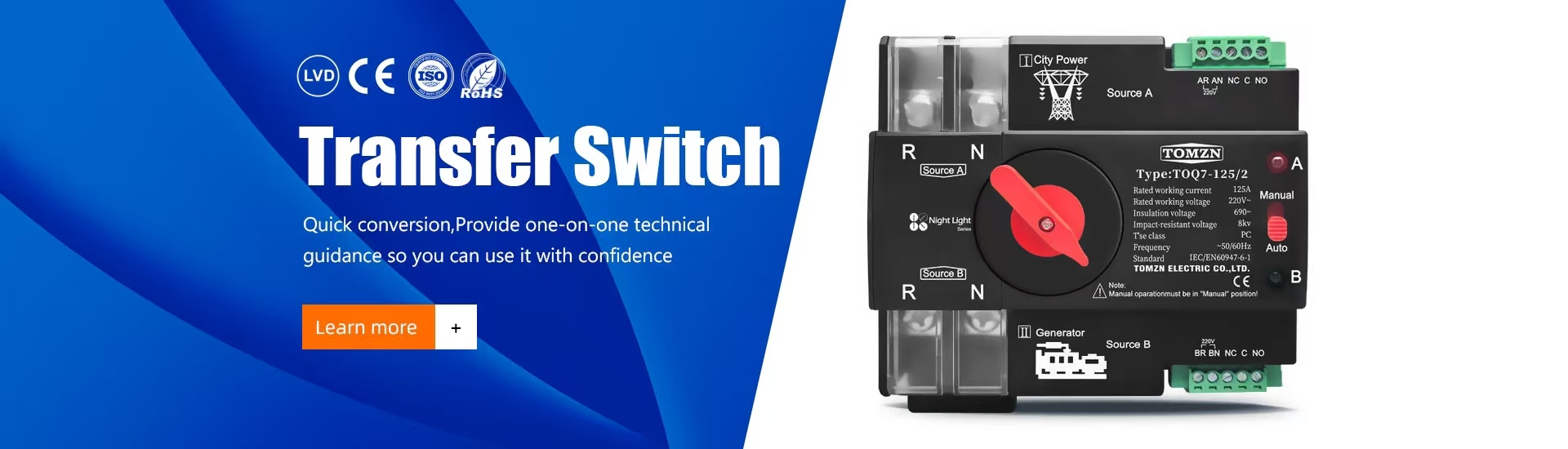
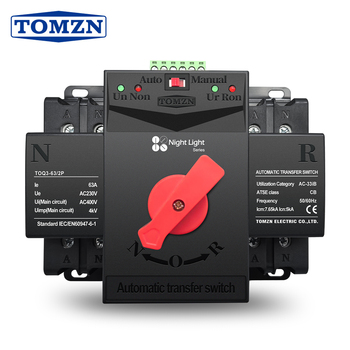
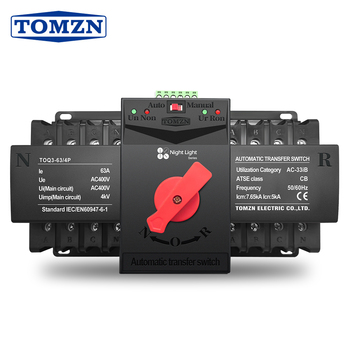
TOQ3 Series 2P Single-Phase ATS
Optimized for 220V/230V or 110V/120V residential and small commercial boards. Features rapid mechanical toggle action, auxiliary contact monitoring, and integrated LED status indication.
Engineered for 380V/400V/415V three-phase installations requiring independent switching of the neutral pole. Prevents circular neutral currents and false tripping of downstream residual current devices (RCDs).
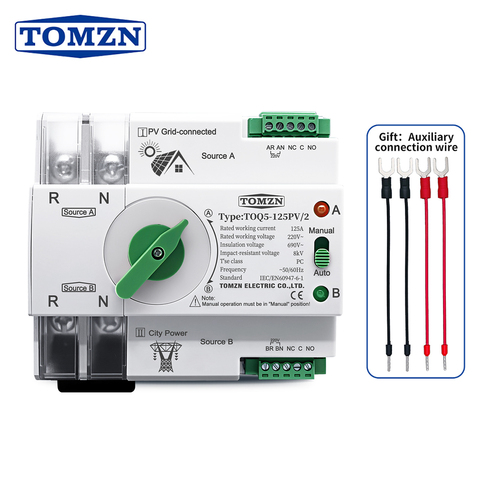
Tailored for rooftop solar battery storage tie-ins. Prioritizes green solar inverter output and automatically transfers to the public utility grid upon battery low-voltage cutoff without back-feeding risk.
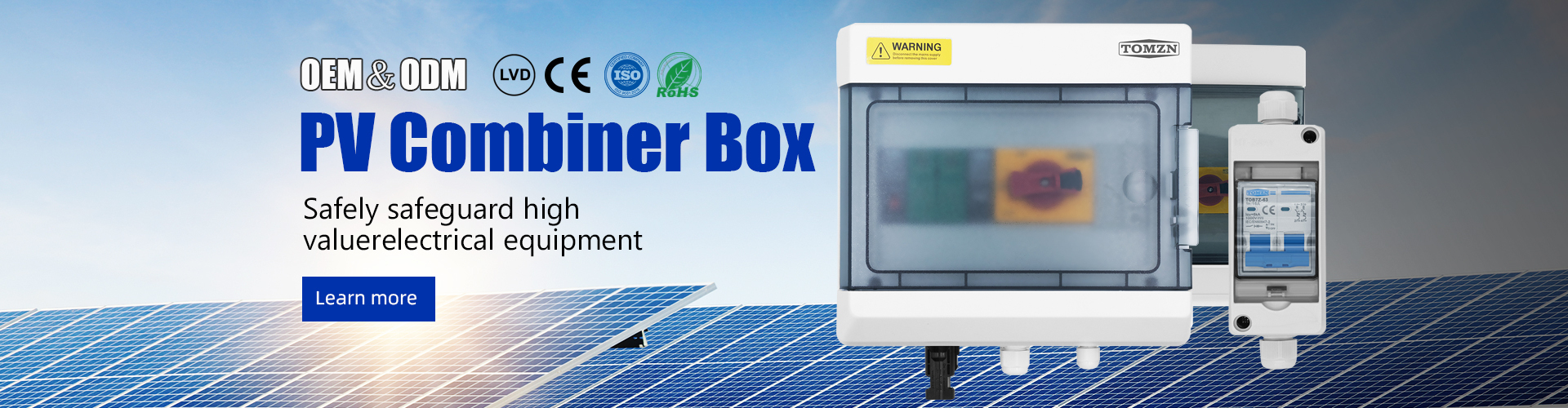
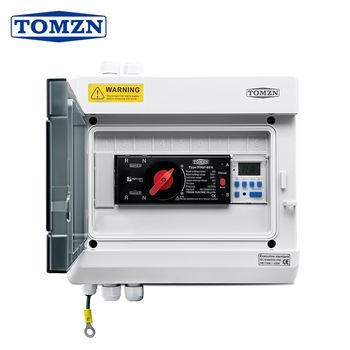
Weatherproof IP65 distribution package combining a 2P/4P dual power ATS, programmable timer switch, and terminal distribution blocks. Ready for rapid on-site installation by solar EPCs.
Selecting Between PC-Class & CB-Class Automatic Transfer Switches
In depth information gain for procurement officers and electrical system design engineers evaluating total cost of ownership, short-circuit withstand ratings, and mechanical durability.
One of the most persistent procurement ambiguities in low-voltage switchboards is distinguishing between PC-Class (Power Contact) and CB-Class (Circuit Breaker) dual power automatic transfer switches. The choice profoundly affects short-circuit coordination, arc dissipation dynamics, and physical footprint inside the switchboard.
PC-Class ATS: These switches are dedicated, mechanically interlocked transfer mechanisms designed exclusively to make, carry, and withstand operating and short-circuit currents. They do not incorporate built-in thermal-magnetic overcurrent trip coils. Instead, their contacts are heavy-duty, monolithic silver alloy pieces capable of enduring high short-time withstand currents (Icw) without welding. Upstream miniature or molded case circuit breakers provide fault clearing. PC-Class devices from Zhejiang TMB Electric Co., Ltd. offer unparalleled mechanical endurance (over 10,000 switching cycles) and exceptionally fast transition times (under 50ms), making them ideal for grid-to-inverter transfers.
CB-Class ATS: Built by mechanically interlocking two individual circuit breakers (MCBs or MCCBs) linked via a motor-driven mechanical arm or solenoid actuator. CB-Class switches provide internal overcurrent and short-circuit protection directly at the switch. If an overcurrent fault occurs on the active circuit, that specific breaker trips independently. However, CB-Class units exhibit slightly longer mechanical transfer delays (typically 100ms to 250ms) due to mechanical operating linkages. For panel builders seeking an all-in-one package that eliminates downstream overcurrent protection, CB-Class is cost-effective, whereas PC-Class is preferred for critical high-speed power transfer.
AC 110V/120V or AC 220V/230V (Single), 380V-415V (3P/4P)
AC 380V / 400V / 415V (3-Phase 4-Wire)
Rated Insulation Voltage (Ui)
690 V AC (50/60 Hz)
800 V AC / 1000 V AC
Operating Transfer Time
< 50 ms (typical 30–45 ms)
120 ms – 250 ms
Utilization Category
AC-31B / AC-33B (IEC 60947-6-1)
AC-33A / AC-35B
Rated Impulse Withstand (Uimp)
8.0 kV
8.0 kV / 12.0 kV
Mechanical Life (Operations)
10,000 Cycles Minimum
8,500 Cycles
Installation Footprint
Standard 35mm DIN-Rail Modular
Chassis Mount / Panel Door Linkage
Strategic Sourcing & Market Intelligence
Future Sourcing & Technological Trends in Dual Power ATS (2025–2030)
What global procurement managers, wholesale electrical distributors, and OEM engineering directors must anticipate as energy grids decentralize.
1. BTM Solar PV & BESS Microgrid Synchronization
The explosive global roll-out of Behind-The-Meter (BTM) energy storage and rooftop solar arrays is forcing a fundamental shift from traditional grid-diesel generator setups to grid-inverter-battery hybrid setups. Future ATS architectures require high-frequency sampling to handle asynchronous phase shifts, preventing harmonic back-feed into inverters during transfer.
2. Smart Telemetry, RS485 & IoT Interfacing
Static mechanical switches are rapidly being superseded by intelligent ATS hardware embedded with RS485 Modbus-RTU, WiFi, or Zigbee microcontrollers. Sourcing agents increasingly specify transfer switches capable of transmitting live line voltage, phase balance, frequency, transfer event counts, and contact thermal health back to central building management systems (BMS).
3. Compacting Footprints for Modular DIN Rails
Panel space within modern residential distribution units is constrained. The industry is trending away from bulky motorized transfer chassis in favor of high-amperage (100A to 125A) compact DIN-rail modules that integrate auxiliary changeover contacts, visual indicator windows, and zero-crossing suppression within standard 35mm enclosures.
As global buyers demand compliance with UL 94-V0 and RoHS-3 directives, low-cost copper-clad aluminum and low-grade plastics are being eliminated from international tenders. Leading distributors prioritize suppliers using high-content silver-nickel (AgNi) or silver-tin-oxide (AgSnO2) contacts that prevent micro-welding during heavy inductive motor inrushes.
Manufacturing Powerhouse
Engineered by Zhejiang TMB Electric Co., Ltd. in Liushi, Wenzhou
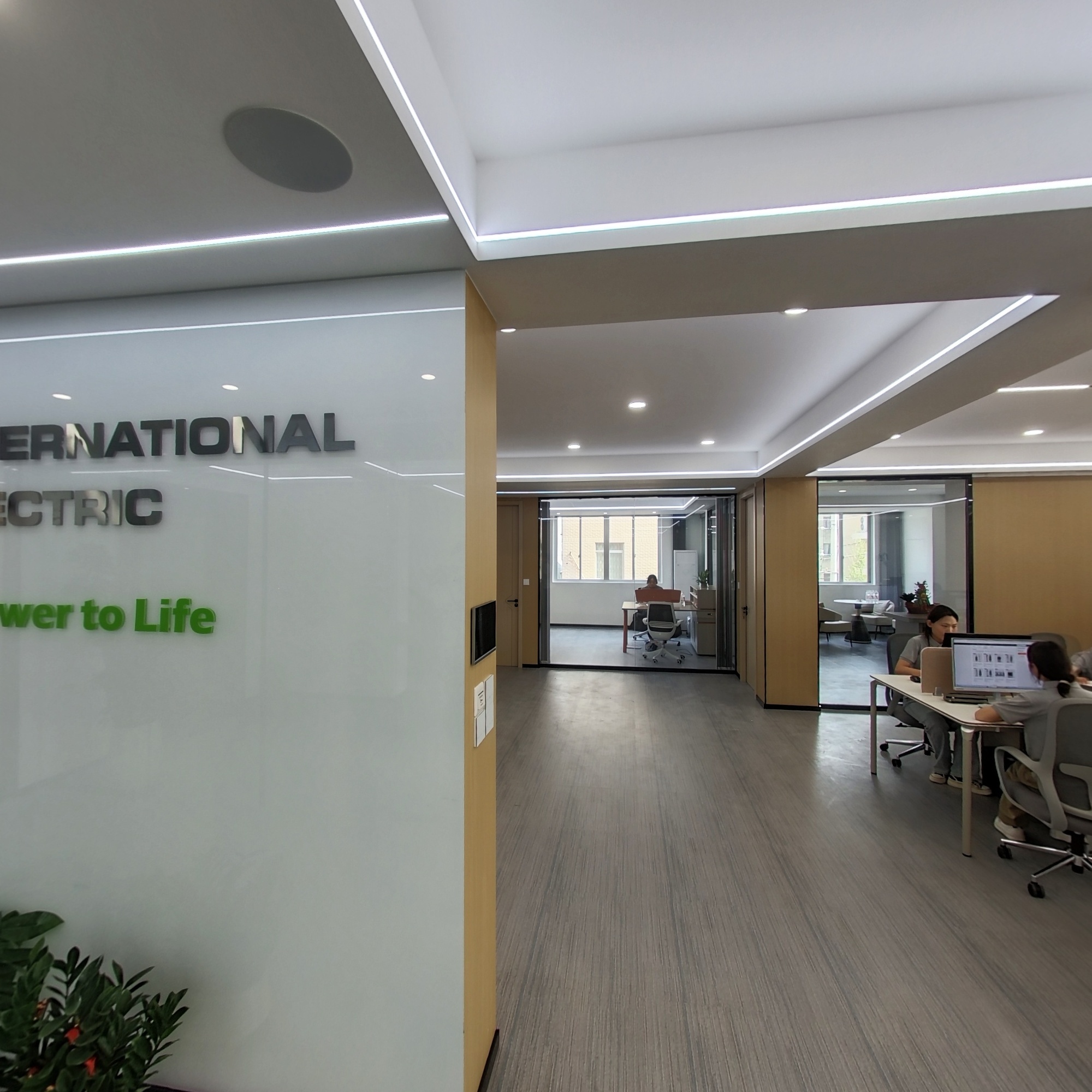
Zhejiang TMB Electric Co., Ltd. has accumulated over 24 years of manufacturing excellence in low-voltage circuit protection, power switching, and solar balance-of-system components. Operating inside the renowned electrical industrial heartland of Huabei Village, Liushi Town, Wenzhou, we leverage a hyper-localized supply cluster where copper pressing, precision stamping, mold injection, and silver contact fabrication occur within a 5-kilometer radius.
This geographic manufacturing advantage enables Zhejiang TMB Electric Co., Ltd. to maintain unmatched quality control across every production stage, drastically reduce tool calibration lead times, and deliver certified circuit protection products at highly competitive direct-factory cost structures.
TÜV Rheinland Audited
5,700 m² modern manufacturing plant fully inspected on-site by TÜV Rheinland specialists.
92 Skilled Electrical Workers
Experienced technical operators, QC inspectors, and electromechanical automation engineers.
Agile OEM & ODM Customization
Custom silk-screen brand printing, customer-specified packaging, voltage presets, and terminal sizing.
Low Trial Minimums (MOQ 5 pcs)
Test real production samples, run bench tests, and inspect finishing before placing container volume orders.
Every single transfer switch leaving our assembly lines undergoes rigorous stress analysis to guarantee zero contact welding, accurate coil release, and absolute phase isolation.
1. Raw Material Assay
Spectrometer analysis of contact silver alloy content and flammability testing of PA66 housings.
2. Torque & Tolerance
Robotic screw torque calibration on power terminals and high-precision mechanical interlock fitting.
3. Millivolt Drop Test
Contact resistance verified across all poles under continuous rated current to prevent overheating.
4. Dielectric Withstand
Testing phase-to-phase and phase-to-ground isolation at 2500V AC to guarantee total open-circuit safety.
5. Transfer Timing Test
Oscilloscope tracking of coil energization, transition time (<50ms), and break-before-make clearance.
6. Packaging Audit
Barcode verification, export master-carton drop testing, manual verification, and customs documentation.
Procurement FAQ
Common Questions B2B Buyers Ask About Dual Power Transfer Switches
Answers to critical technical and logistical questions compiled by our senior application engineering and export team.
How do I properly size a Dual Power Automatic Transfer Switch for inductive vs resistive loads?
For purely resistive loads (such as electric heaters and resistive incandescent lighting), an ATS can be specified at 100% of nominal continuous circuit amperage. However, when switching inductive and capacitive loads—including air conditioning compressors, water pumps, elevator motors, and industrial rectifiers—starting surge currents can reach 6 to 8 times the nominal full-load amperage (FLA). In these cases, engineers should choose an ATS certified under IEC 60947-6-1 utilization category AC-33B/AC-33A, or derate an AC-31B rated switch by 25% to 40% (for example, utilizing a 100A or 125A ATS for an actual 63A inductive motor circuit) to prevent contact erosion, thermal buildup, and micro-welding during motor start-up transitions.
Why do conventional dual power transfer switches fail when switching between the utility grid and solar PV inverters?
Conventional switches designed exclusively for utility-to-generator changeover assume the backup source is an asynchronous rotary generator that comes online after a spin-up delay. In contrast, grid-to-inverter transfers involve active electronic AC synthesis from off-grid or hybrid solar inverters. When transferring without synchronized zero-crossing, the counter-electromotive force (back-EMF) from running motors or transformers can produce large out-of-phase voltage spikes. If the ATS contacts bridge both sources even momentarily, or if the arc sustains across the gap, high fault current can back-feed directly into the inverter bridge, destroying power MOSFETs and welding switch contacts. Zhejiang TMB Electric Co., Ltd. dual power ATS devices employ an optimized mechanical break-before-make linkage, dual deionizing arc chutes, and heavy air gaps to completely isolate the utility grid from the solar inverter terminals.
When must a buyer specify a 4-Pole (4P) ATS instead of a 3-Pole (3P) ATS in three-phase systems?
A 4-Pole ATS is mandatory in three-phase electrical systems whenever the standby power source (generator or solar energy storage inverter) has its own independently bonded neutral conductor (Separately Derived System), or whenever Residual Current Devices (RCDs) / Ground Fault Circuit Interrupters (GFCIs) are deployed upstream or downstream of the transfer switch. If a 3-Pole switch is used with a common, continuous solid neutral, circulating neutral currents will travel across both grounds, causing constant nuisance tripping of safety RCDs and impairing ground-fault fault protection. Specifying a 4P ATS ensures the neutral conductor is switched simultaneously with the phase conductors, eliminating ground loops and ensuring compliance with electrical wiring codes.
What is the mechanical transfer time of TMB DIN-rail dual power transfer switches?
The total mechanical transfer transition time of Zhejiang TMB Electric Co., Ltd. DIN-rail modular switches (such as the TOQ3 series) is less than 50 milliseconds (typically 30ms to 45ms). While not an instantaneous zero-millisecond static solid-state UPS transfer, this high switching speed ensures that contactors do not release, incandescent and LED lighting circuits do not visibly shut down, and consumer electronics, PCs, and WiFi routers equipped with standard internal capacitive hold-up supplies remain fully powered without unexpected reboots.
Can Zhejiang TMB Electric Co., Ltd. produce 110V/120V 60Hz ATS units for American and Caribbean markets?
Yes. As a primary manufacturer with our own coil winding and assembly lines in Liushi, Zhejiang TMB Electric Co., Ltd. manufactures dedicated 110V, 120V, and split-phase 208V/240V 60Hz coils and mechanisms for the Americas and the Caribbean, as well as standard 220V/230V/240V 50Hz models for European, Middle Eastern, African, and Asian power grids. Simply specify your rated nominal operating voltage (Ue) and frequency during inquiry.
What quality documentation and customs certifications are provided with shipments?
Every shipment can be accompanied by complete factory routine test certificates, dielectric withstand test logs, full technical specification sheets, and CE declarations of conformity under IEC/EN 60947-6-1. In addition, our manufacturing facilities operate under certified quality management systems and maintain an audited on-site supplier evaluation assessment issued by TÜV Rheinland.
Ready to Source Certified Dual Power Automatic Transfer Switches?
Send us your project specifications, single-line diagrams, voltage requirements, and required order quantities. Our engineering sales team will respond promptly with full technical datasheets and competitive direct-factory pricing.